
Chaos & Control
A podcast about birth control in America
All episodes of Chaos & Control are out now on Spotify and Apple Podcasts.

Chaos and Control is a documentary-style limited series exploring the story of birth control in America. It takes a critical look at the history of the birth control movement and development of the pill, the work and impact of various women's health movements, the criminalization of contraception and abortion, and the social and cultural systems that have shaped the current conversation around birth control.
Like, what is the role of hormonal birth control in a post-Roe America? Is birth control toxic? Why are so many women sharing their negative experiences? What does contraception free from coercion look like? Is it possible to critique forms of contraception without compromising bodily autonomy, and how? And most importantly, how did we get here? Explore these questions and more — as well as interviews with historians, sociologists, doulas, and young people with a range of birth control experiences — in Chaos & Control.
A guide to the episodes ⟢
-
In this episode we set the stage for our exploration of birth control:
✦ What did birth control look like before the pill?
✦ Why the conversation of is the pill good or bad, safe or toxic, is incomplete. It’s ultimately about the system in which it’s embedded, and how that system uses and mis-uses it
✦ How contraception in general is essential for reproductive autonomy — the key is what form that contraception takes, what risks it does or does not come with, and how freely it is chosen
✦ Why Roe was never enough & how birth control criticism gets weaponized by the right
✦ How reproductive choices aren’t made in a vacuum, and how certain political forces shape women’s birth control decisions
✦ Why increasing access to contraception is not a viable alternative to abortion (shout out to Dr. Krystale Littlejohn)
✦ The difference between being critical of the ways in which certain contraceptive methods have been harmful to women’s health and autonomy, and opposing contraception in general
✦ What body literacy and reproductive justice are, and how they are both vital for creating a reproductive future which is liberatory for all -
In this episode we dive into the complicated, dark history of the birth control movement, and the effects that legacy still has today:
✦ The origins of obstetrics and gynecology, and how white physicians who wanted to professionalize medicine worked to take over the field from midwives, who were primarily Black, Indigenous, and immigrant women
✦ How the Victorian era changed mainstream understandings of sex and reproduction and forced a lot of birth control knowledge underground
✦ The Voluntary Motherhood movement and the ongoing pattern of white women turning towards white supremacy for perceived safety and power, at the expense of other women (and often, at the expense of themselves)
✦ The Comstock laws (very relevant to this week’s Supreme Court hearings on the abortion pill) and the history of abortion restrictions in the United States
✦ How Margaret Sanger’s alliance with the eugenics movement helped shape many of our contemporary reproductive policies
✦ How contraception has been used as a tool of population control, and the legacy of state-sanctioned reproductive violence in the United States
✦ What a better birth control movement might look like -
In this episode, we zoom in on the birth of the oral contraceptive pill – and the science, social backdrop, and exploitation of women that made it all possible.
We dive into:
✦ The major players in birth control’s origin story, from Katherine McCormick, wealthy heiress and second woman to graduate from MIT, to mad scientist Gregory Pincus, to catholic doctor John Rock
✦ The women subjected to nonconsensual medical experimentation in Puerto Rico, Haiti, and poor communities in the US — and how they were exploited and then disregarded after the trials ended
✦ How the birth control pill came to be seen as a “magic bullet” against communism and the “population bomb” that threatened to undermine American imperialism
✦ Why overpopulation is a myth, and how that myth gets weaponized against women of color, immigrant women, and poor women
✦ The relationship between the pill and the sexual revolution
✦ Why Playboy Magazine and the Beat poets disagreed about the pill and masculinity
✦ The consequential Nelson Pill Hearings, and how the info sheets included alongside all prescription medications are a result of a women’s health group protesting those hearings
✦ The legacy of the radical women’s health movements of the ‘70s, and how the far right and their “war on abortion” partially caused feminist skepticism of the pill to become a reluctance to say anything bad about hormonal birth control -
In this episode we explore the reproductive violence done under the guise of progress and humanitarian aid, through the lens of three different long-acting contraceptive technologies: The Dalkon Shield IUD, the Norplant Implant, and the Depo-Provera injection.
We go into:
✦ The history of the IUD, and how at least 18 women died and thousands of others suffered life-threatening infections, miscarriages, chronic pain, and even sterilization from the Dalkon Shield IUD due to corporate greed and negligence
✦ How the Norplant implant was touted as the solution to poverty — and the hundreds of thousands of women that idea harmed
✦ How the topic of welfare became increasingly racialized — despite that fact that the welfare system, has always benefitted white Americans more, and that it actually excluded Black Americans for much of its history
✦ How anxieties around welfare and crime led to create a moral panic that worked to propel coercive birth control policies
✦ Why the idea that women didn’t work before the mid 1900s is incomplete and leaves out the majority of women
✦ Depo-Provera’s legacy of harm as “humanitarian aid” in Africa, South America, and Southeast Asia
✦ How Depo was given to hundreds of thousands of women in the US – primarily poor, Black and Indigenous women – through government-funded programs, BEFORE it was ever approved by the FDA
✦ Why the FDA finally approved Depo after 3 failed attempts, just months after they called it “pervasively carcinogenic” -
In this episode, we dive into menstrual suppression. We explore the ways in which women’s bodies and health have been and continue to be disregarded by the medical system, how pharmaceutical companies have co-opted feminist language in order to market new contraceptives, and the shifting social and political landscape in which criticism of the pill was increasingly seen as a conservative thing.
We go into:
✦ How the side effects of the pill increasingly became the main effects
✦ The origins of the pro-life movement in the United States
✦ How the rise of the far right and their war on abortion made birth control an increasingly polarized issue and pushed some feminists towards the side of the pharmaceutical companies
✦ How pharmaceutical companies co-opted third-wave feminist language in order to sell new contraceptives
✦ The rise in neoliberalism, any hoe neoliberal choice feminism fueled menstrual suppression
✦ The idea of contraception as harm reduction
✦ How contraceptives are used as stopgaps in a system that can’t be bothered to take women’s wellbeing seriously and find real solutions -
In this episode we dive deeply into period stigma and the pathologization of periods, as well as the epidemic of severe menstrual pain and how our current system fails women. We also explore the importance of ovulation, and what we lose when we consider periods to be optional.
We go into:
✦ Period stigma and how it’s rooted in a lack of respect for the female body
✦ How to navigate period pain in a medical landscape full of gaslighting and menstrual suppression
✦ The importance of ovulation, and why the function of ovulation is far from just getting pregnant
✦ How your period is a vital sign and the implications of getting rid of that valuable marker of health
✦ The idea of epistemic injustice, and how knowledge of our bodies and cycles is intentionally obscured to maintain social control
✦ How a lack of full and accurate information about our bodies has serious consequences for our health and wellbeing, as well as for our ability to make autonomous reproductive choices and navigate this increasingly hostile reproductive environment -
In this episode, we explore the crucial question: what are we getting wrong when it comes to our conversations around hormonal birth control post Roe – and are we even having the right conversations?
First, we take a look at the idea of choice, a cornerstone of the modern reproductive rights movement. We’re asking, what are the limitations of focusing on choice in conversations around reproductive rights – and what are the alternatives?
Then we take a look at how women are socialized into using certain forms of contraception, and the social pressures that women face when trying to opt for non-hormonal methods.
Finally, we get into one of our key questions: why is it so hard to critique the pill, and what do we lose when we lump genuine criticism of certain birth control methods in with conservative misinformation? -
In all the conversation about birth control, you’ve likely heard at least one person mention the fertility awareness method, or the idea that you can track your menstrual cycle as a form of contraception.
And, you’ve likely heard more than one person deride this as unreliable or dangerous pseudoscience.
But what exactly is the fertility awareness method, and where did it come from?
Is it an actually viable method of contraception, or is nothing more than misinformation and wellness industry nonsense?
In this episode, we’re diving into all of that.
We explore the science, the history, the politics, and the many misconceptions surrounding fertility awareness.
We also looking at the idea of expertise – from who we consider to be experts, to the role of influencers in the women’s health space. -
In this episode, we explore the idea of body literacy as reproductive resistance in post-Roe America.
Though the interviews were done and the bulk of episode was written months ago, this week it became all the more relevant.
It was recorded two days after Donald Trump was elected president for the second time.
As we talked about in earlier episodes, after he was elected in 2016 there was a documented spike in women getting IUDs, implants, and hysterectomies as a precautionary measure against reproductive care restrictions.
Now, facing a second Trump presidency, and with Roe V Wade overturned, many are feeling similar or intensified anxieties about their ability to access birth control and abortion in this country.
Amidst all this anxiety and uncertainty, can body literacy offer a guiding light for navigating our reproductive autonomy in the face of reproductive oppression? -
n our final episode of the series, we’re looking to the future 🔮
We look back at some of the central questions we set out to answer in this series, before answering the most important question of all: what do we do next?
You’ll hear once again from several of our guests on their ideal vision for the future.
✨ Sociologist Dr. Krystale Littlejohn shares what a reproductively just approach to birth control looks like
🩸 Philanthropist Chelsea VonChaz shares about the importance of menstrual education
🌀 Body literacy educators Sarah Bly and Nicole share their visions for comprehensive body literacy education that can take us from menarche to menopause
Together, their wisdom charts a course towards a future which is supportive, empowering, & liberatory for all.
✷ Meet (some of) the Interviewees
-

Dr. Krystale Littlejohn
SOCIOLOGIST
Krystale E. Littlejohn is an associate professor of sociology at the University of Oregon and author of the award-winning book Just Get on the Pill: The Uneven Burden of Reproductive Politics (UC Press, 2021). She earned her PhD from Stanford University in 2013 and her BA from Occidental College in 2007. Her work examines race, gender, and reproduction. She has received funding for her work from the American Association of University Women (AAUW), the Society of Family Planning Research Fund, and the ASA Minority Fellowship program, among other funders. Her next book, Fighting Mad: Resisting the End of Roe v. Wade, co-edited with historian Rickie Solinger, highlights how people across domains are fighting to protect abortion access in the wake of the Supreme Court’s decision to overturn Roe v. Wade. You can learn more about her work at krystalelittlejohn.com.
-

Dr. Ann Hibner Koblitz
HISTORIAN & AUTHOR
Ann Hibner Koblitz is a professor emerita, retired from the Women & Gender Studies Program at Arizona State University. She is the author of three books and numerous articles on various aspects of gender and science. Her third book, Sex and Herbs and Birth Control: Women and Fertility Regulation through the Ages, won the Transdisciplinary Book Award of the ASU Humanities Institute. She is also the founder/director of the Kovalevskaia Fund for women in science in Asia, Africa, and Latin America. Occasional blog posts on women's reproductive health and information on her third book can be found at ahkoblitz.wordpress.com.
-

Chealsea VonChaz
PHILANTHROPIST, FOUNDER & PERIOD DOULA
Hollywood stylist turned philanthropist Chelsea VonChaz is your go-to girl when you need to talk about your period. As the executive director of the #HappyPeriod charity, which provides menstrual care and health education to people with periods, Chelsea promotes the inclusion of womb care within wellness. By curating safe spaces inspired by her Afro-Indigenous roots, her mission is to help advance reproductive care and wellness through body literacy. She is also the founder of Menärchē, the newsletter for the culture’s reproductive wellness. You can learrn more about her work at chelseavonchaz.com.
-
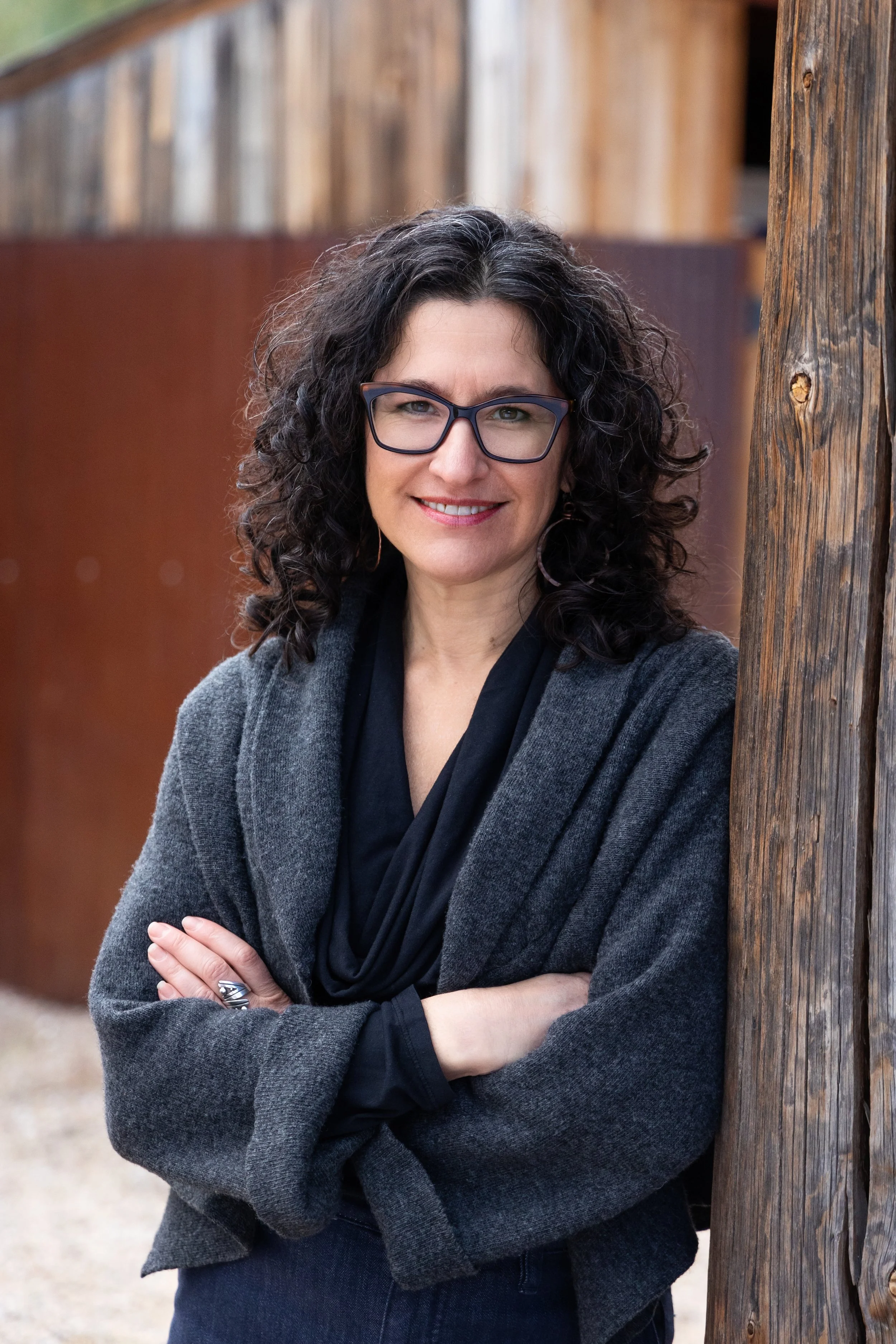
Jennifer Block
INDEPENDENT JOURNALIST & AUTHOR
Jennifer Block is an independent journalist who writes frequently about health, gender, and contested areas of medicine. Her articles and commentary have appeared in The Boston Globe, Romper, The BMJ, The Cut, The New York Times, The Baffler, and many other outlets.
As a reporter with Type Investigations, Jennifer won several awards for her investigative reporting on the permanent contraceptive implant Essure, which was subsequently removed from the market. For early chapters of Everything Below the Waist, she won a Whiting Creative Nonfiction Grant.
Her first book, Pushed, led a wave of attention to the national crisis in maternity care and is a foundational text in university curricula and birth worker training. It won a “Best Book” designation from Kirkus Reviews and was named a “Best Consumer Health Book” by Library Journal.
Jennifer began her career as an editor at the legendary Ms. magazine and contributor to The Village Voice and The Nation. She has given interviews to national media outlets and is a featured expert in Ricki Lake and Abby Epstein’s 2022 film The Business of Birth Control.
-

Sarah Bly
FERTILITY AWARENESS EDUCATOR
Sarah Bly is a Sexual Health Educator and a Certified Fertility Awareness Educator with over twenty years of teaching experience nationally and internationally. She originally trained and served as a homebirth midwife but has found her passion in body literacy and health education. She is the founder and facilitator of the only professionally recognized Fertility Awareness and Body Literacy teacher training program in the USA and has a thriving private practice as well. Sarah is a member of several professional organizations and is dedicated to furthering our embodiment, empowerment, sexual sovereignty and connection with the natural world. She resides in southern Oregon where she mothers, farms, dances and lives in reverence to the natural world. You can learn more about her work and connect with her at graceofthemoon.com.
-
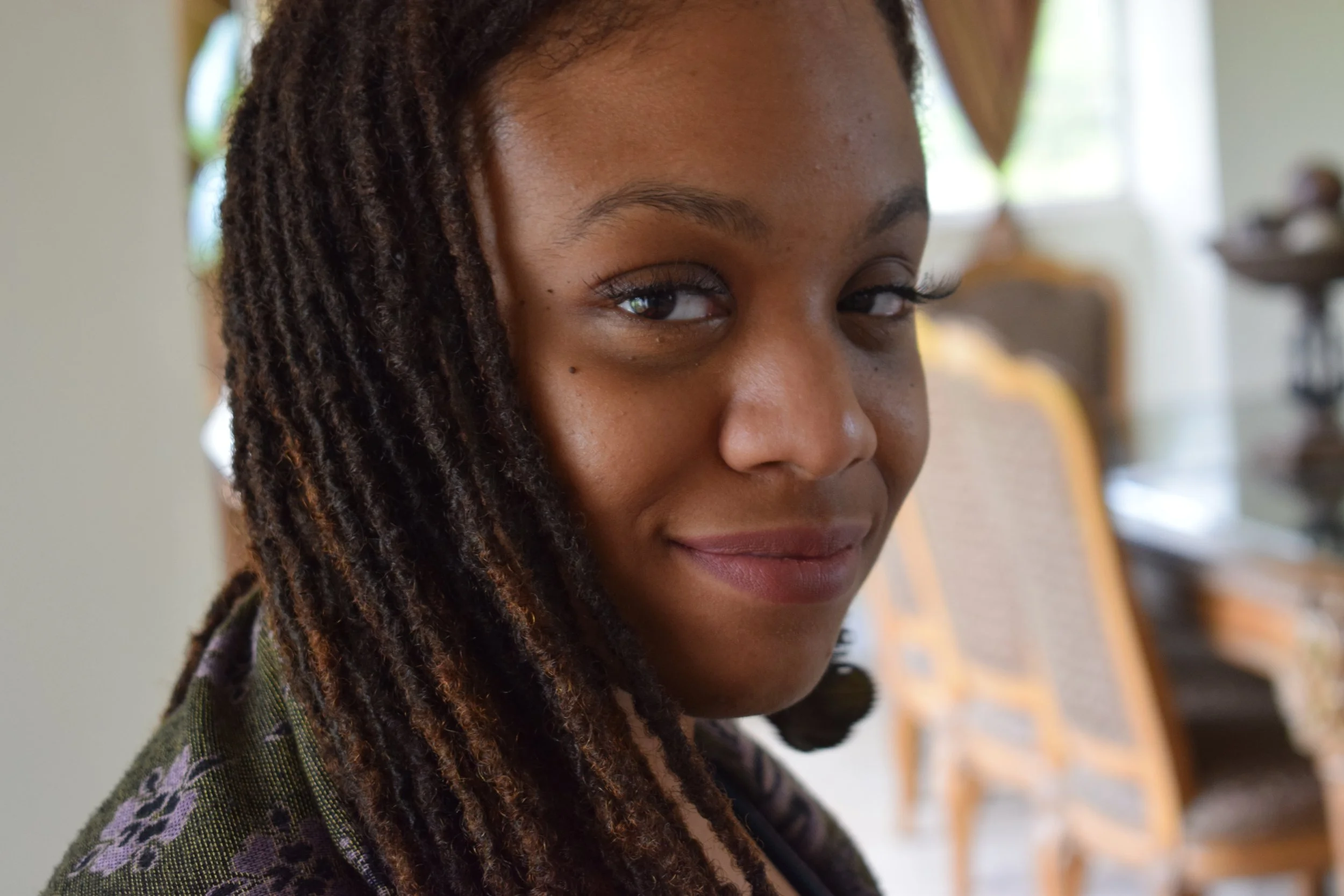
Hājar Danielle
DOULA & REPRODUCTIVE HEALTH ACTIVIST
Hājar Danielle is a full spectrum doula and reproductive health activist based in Broward County, Florida. Hājar is the descendant of Florida granny midwives and aims to revive her ancestors' practices in response to the black maternal health crisis. Her other focus is giving people the tools to survive the reproductive violence occurring in the U.S. today. You can connect with her and learn more about her work at yungmedusa.com and @yungmedusa on twitter.
-

Nicole
BODY LITERACY EDUCATOR
Nicole @ Learn Body Literacy is a fertility awareness educator, urban farmer, theorist, and mixed media artist. She teaches menstrual cycle awareness through the lens of body literacy. She also hosts the Someone, Somewhere Podcast, where she relays information about history, fertility, sustainable agriculture, and their subsequent connections. She is currently writing a book about fertility awareness and what she terms “strategies for autonomous menstrual management” while working with clients on their individual menstrual needs. You can connect with her and learn more about her work at learnbodyliteracy.com.
So now what?
aka, what to do about what you just heard.
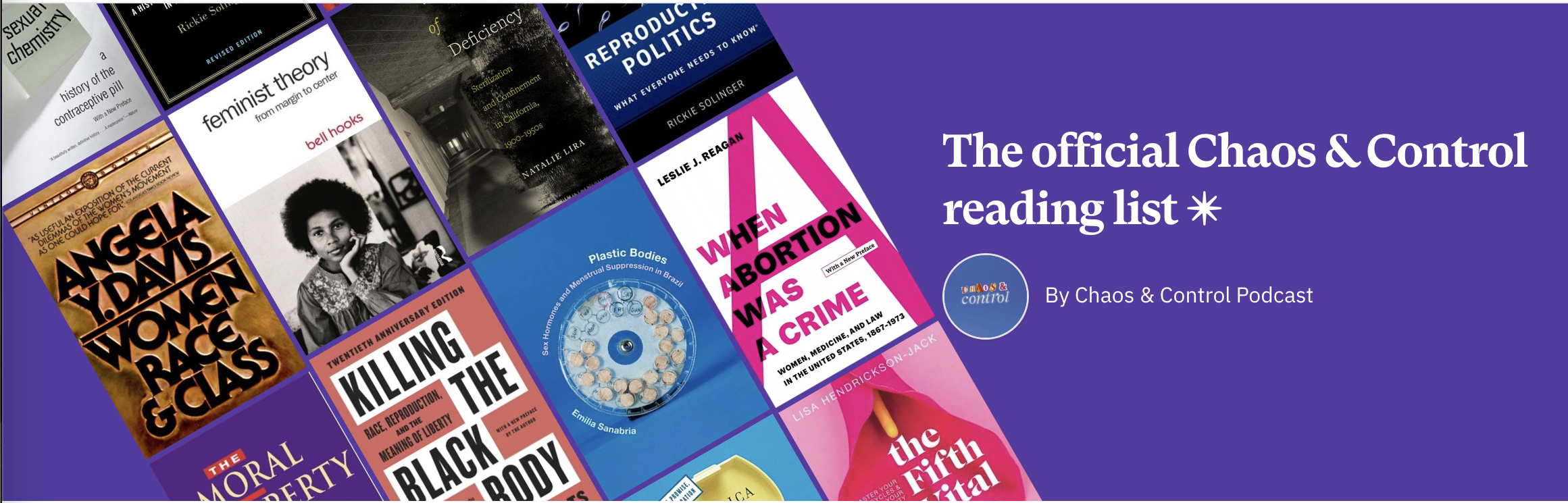
✷ Go Deeper: Explore these topics further with the official Chaos & Control Reading List
Click here to find all of the books referenced throughout the podcast, plus a few others on reproductive justice & body literacy.
✦ Support the work: Reproductive Justice Organizations
✦ Sistersong Women of Color Reproductive Justice Collective. “SisterSong is a Southern based, national membership organization; our purpose is to build an effective network of individuals and organizations to improve institutional policies and systems that impact the reproductive lives of marginalized communities.” Learn more and donate here.
✦ In Our Own Voice: National Black Women's Reproductive Justice Agenda. “In Our Own Voice is a national-state partnership focused on lifting up the voices of Black women leaders at the national and regional levels in our fight to secure Reproductive Justice for all women, girls, and gender-expansive individuals.” Learn more and get involved here.
✦ #HappyPeriod (founded by podcast interviewee Chelsea VonChaz). “Our mission is to produce programs with love centered on menstrual care. We are committed to reshaping the discussion surrounding menstruation while bridging access to education and safe products for underserved periods. #HappyPeriod strives to eliminate the stigma on menstruation by reshaping the discussion surrounding it, while also providing accessible period care and education. One of #HappyPeriod’s main purpose is to cultivate programs that promote better healthcare, ally-ship, access, and education centered on menstrual health. Our intention is to be an advocate encouraging body literacy for Black Women, Girls, Femmes, and Non-binary or gender expansive humans.” Learn more and donate here.
✦ If/When/How: Lawyers for Reproductive Justice. They run the Repro Legal Helpline, which offers free, confidential legal services about reproduction, including abortion, pregnancy loss, and birth. They also run the Repro Legal Defense Fund, which provides financial support for people investigated or fighting charges related to their pregnancy or abortion.
✦ Plan C Pills. Plan C is an information and resource hub about the abortion pill. From medical questions, to logistical and emotional support, to sourcing. You can get support or donate here.
This is an evolving list that will continue to grow. Is there a local reproductive justice organization you support & would like to see included? Reach out & let us know about it!
☾ Learn: Body Literacy Resources
Learn Body Literacy by podcast interviewee Nicole
Learn Body Literacy is a resource hub for body literacy, reproductive health, and fertility awareness. They have workshops, workbooks, & courses. Here is a guide on how to choose a fertility awareness instructor &/or how to effectively teach yourself the method.
The Well School of Body Literacy by podcast interviewee Sarah
The Well offers sexual and hormonal health education as well as health coaching consultations based on practical yet powerful self-care skills within a functional medicine model of care. They offers programs for those seeking support with their health and cycle charting practice as well as many programs designed for healthcare providers seeking to serve their clients better.
Books & apps 〰
✦ Check out the body literacy book list here
✦ Conscious Contraception Skillshare Workbook by Samantha Zipporah
Apps that actually protect your privacy:
✦ Read Your Body cycle tracking app. They're a community-driven, women-led non-profit app where your data is fully encrypted and only stored on your phone so they can't even see it, let alone share or sell it. Good for charting with the symptothermal fertility awareness method.
✦ Stardust. Combines period tracking with astrological insights — and they’re women-led and end-to-end encrypted. Good for tracking your period.
✦ Drip. An open-source cycle tracking app that keeps your data private and on your phone. Good for tracking your period or charting with the symptothermal fertility awareness method.